
Table of Contents
- Preparing Concrete Surfaces for Lasting Epoxy Results in Western Canada
- Core Principles of Concrete Grinding and Surface Preparation
- Professional Equipment and Techniques for Superior Concrete Preparation
- Applying Concrete Preparation to Real-World Projects
- Maximizing Epoxy Floor Longevity Through Precision Preparation
- Frequently Asked Questions About Concrete Grinding and Surface Preparation
- Partner with Epo-Tech for Expert Concrete Surface Preparation
Preparing Concrete Surfaces for Lasting Epoxy Results in Western Canada
Proper surface preparation is the cornerstone of any durable epoxy flooring installation, and for concrete grinding and surface preparation in Edmonton and across Western Canada, the demands are greater. Without a meticulously leveled and cleaned substrate, coatings can fail, leading to costly repairs and reduced lifespan.
In Western Canada, seasonal freeze-thaw cycles pose unique challenges. Moisture penetrates porous concrete, and when temperatures drop, the expansion can cause cracking and spalling. This climate-specific reality means that preparation must go beyond basic cleaning. Professional assessment and mechanical grinding are essential, as they close the substrate’s pores to create a dense, low-porosity surface that resists moisture ingress.
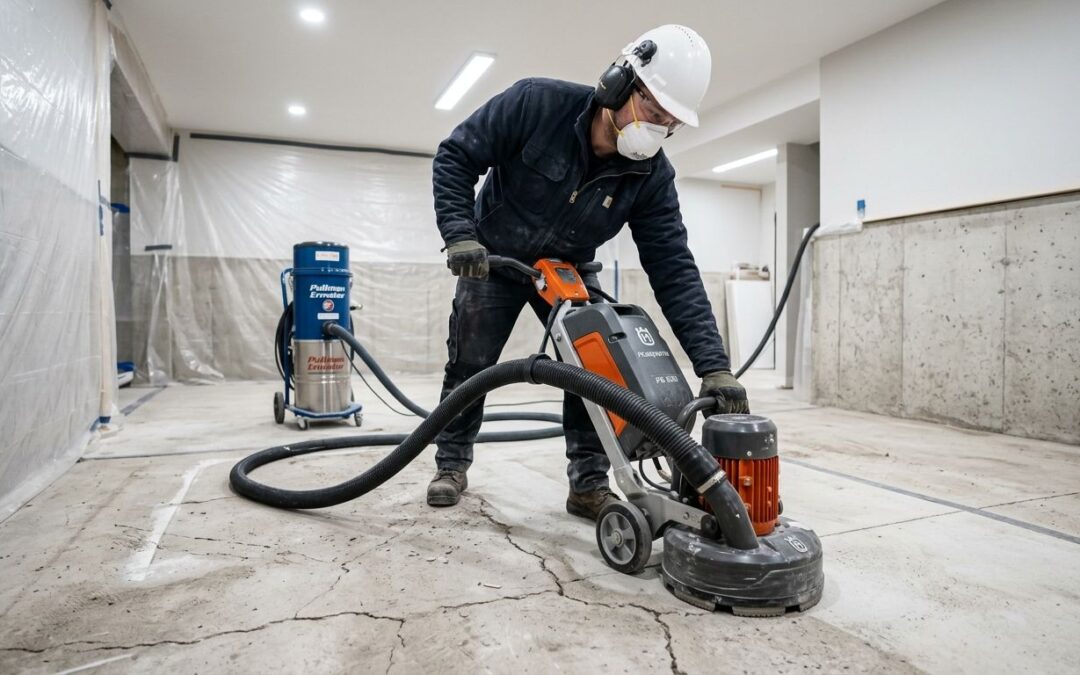
At Epo-Tech, our approach to grinding combines advanced diamond-tipped equipment with HEPA-filtered dust extraction systems that capture hazardous silica particles and comply with local environmental regulations. By selecting the appropriate sequence of diamond grits—from coarse 30/40 grit for initial levelling to fine 3000 grit for a polished finish—we can achieve anything from a non-slip matte to a high-gloss surface while ensuring a strong bond for subsequent coatings. We provide tailored estimates for every project, ensuring your surface preparation is customized to the specific condition of your slab and your desired finish.
Mastering these preparation fundamentals is the basis for the core principles of concrete grinding and surface preparation that follow. Our team is ready to design and install the decorative concrete surface that is right for you.
Core Principles of Concrete Grinding and Surface Preparation
Proper concrete grinding and surface preparation in Edmonton and Kelowna begins with core principles. Surface preparation accounts for roughly 90% of the total epoxy application workflow.
We use equipment with abrasive diamond tools to remove surface irregularities, laitance, and old sealers, producing the concrete surface profile (CSP) textures—commonly CSP 1 or CSP 2—required for thin-film residential and light commercial epoxy systems.
Moisture vapor is the most frequent cause of epoxy failure, so moisture control is central to our process. We verify slab conditions with the plastic sheet test, sealing polyethylene at least 2 feet by 2 feet to the floor and observing it for 24 to 48 hours; condensation beneath the sheet indicates excess vapor that must be mitigated before coating.
Deep cleaning and degreasing eliminate soluble contaminants, while mechanical grinding strips oils and old sealers that chemical treatments cannot fully remove. Where concrete shows cracks or spalls, we V-groove affected lines to allow patching compounds to penetrate and lock mechanically into the substrate, restoring a continuous, sound surface.
The preparation step is thorough vacuuming to remove all dust and particles so the substrate is clean and ready for coating.
| Aspect | Diamond Grinding | Acid Etching |
|---|---|---|
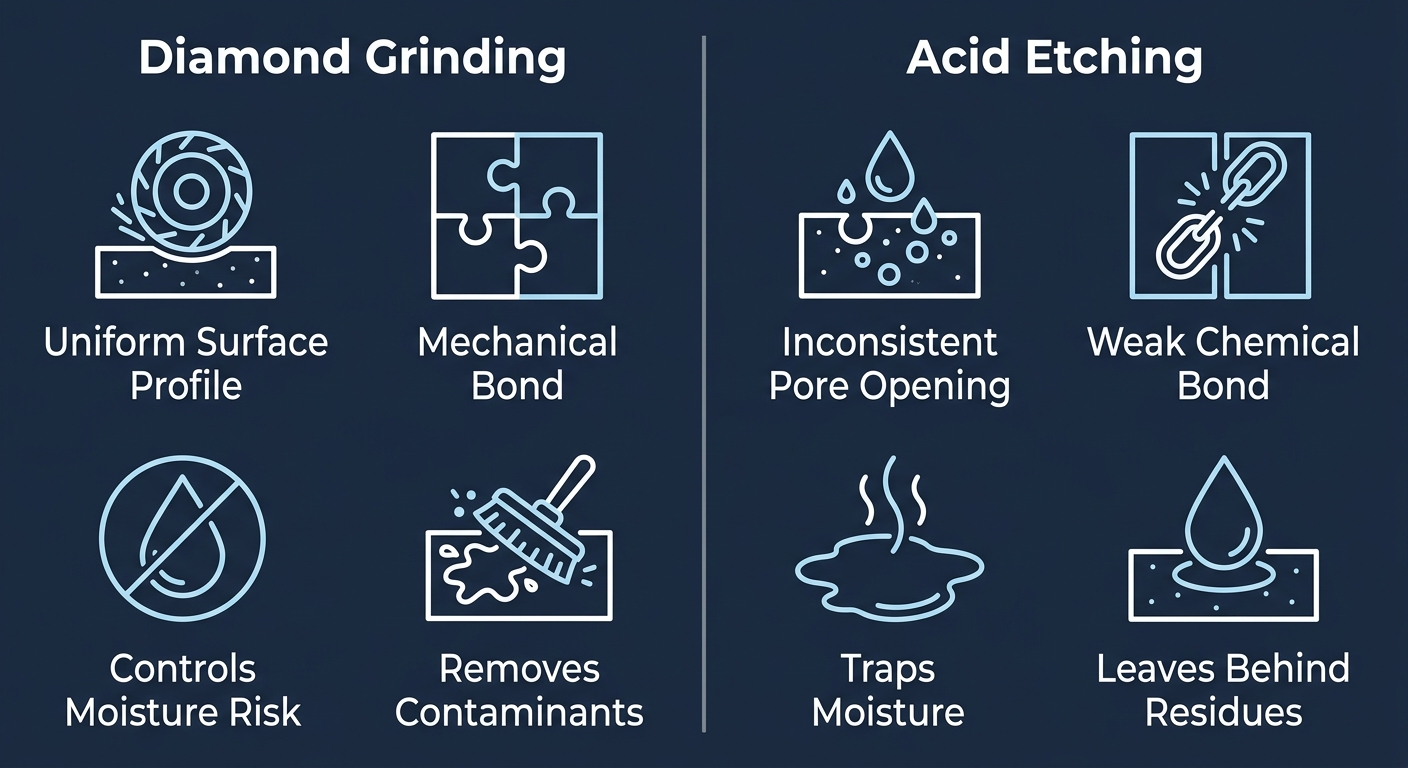
| Surface Profile | Creates a uniform CSP by mechanically abrading the surface, removing laitance and exposing sound concrete for bonding. | Opens pores through chemical reaction but does not create a true mechanical profile; less effective on dense or hard-troweled concrete. |
| Adhesion Reliability | Produces a consistent mechanical bond throughout the slab; no chemical residues interfere with epoxy adhesion. | Can leave behind acid residues that weaken adhesion; bond quality varies significantly across the surface. |
| Moisture Risk | Reduces moisture entrapment risk by physically profiling the surface without introducing liquid chemicals. | May trap moisture under the coating when acid and rinse water are not fully extracted from the substrate. |
| Contaminant Removal | Physically removes oils, existing sealers, and surface contaminants as part of the abrasion process. | Does not remove oils or existing sealers; these contaminants can prevent proper bonding even after etching. |
| Overall Recommendation | Preferred method for all epoxy projects requiring reliable, long-term adhesion. | Not recommended for critical bond areas or projects where coating failure is unacceptable. |
Professional Equipment and Techniques for Superior Concrete Preparation
Building on these core principles, professional contractors rely on specialized equipment and techniques to achieve superior concrete preparation. This section examines the key equipment and techniques that ensure optimal adhesion, long-term durability, and workplace safety.
Diamond Grinding Equipment for Consistent Surface Profiles
Diamond grinding represents the preferred method for achieving a uniform surface profile across concrete slabs. We use industrial diamond grinders with rotating discs embedded with diamond segments that progressively refine the concrete surface.
Grinding creates the mechanical "tooth" or texture that epoxy coatings need for proper adhesion. The International Concrete Repair Institute defines surface roughness using a Concrete Surface Profile scale from 1 to 10, with most thin-film residential epoxy systems requiring CSP 1 or CSP 2 levels. Acid etching alone often cannot produce a reliable profile on dense or hard-troweled concrete.
| Grit Sequence | Surface Profile (CSP) | Resulting Finish | Typical Application |
|---|---|---|---|
| 30/40 Metal-Bond | CSP 2-3 | Rough texture with visible aggregate | Heavy coating removal and bonding profile creation |
| 60/80 Metal-Bond | CSP 4-5 | Medium texture suitable for adhesion | General concrete preparation for epoxy and other coatings |
| 100/200 Resin-Bond | CSP 6-7 | Smooth finish with minimal visible aggregate | Final preparation before thin-mil coating application |
| 400-3000 Resin-Bond | CSP 8-9 | Glossy sheen with reflective qualities | Polished concrete finish for decorative applications |
In Edmonton’s climate, the grinding process must account for freeze-thaw cycles to avoid future cracking and ensure long-term floor integrity.
Shot Blasting and Scarifying for Heavy-Duty Removal
When surface conditions require aggressive material removal, shot blasting and scarifying provide heavy-duty mechanical alternatives to diamond grinding. Shot blasting propels steel shot at high velocity onto the concrete surface, removing contaminants and creating a uniform profile. Scarifying uses rotating cutting wheels to fracture and remove surface layers.
We deploy shot blasting equipment on large warehouse and manufacturing floors where extensive surface area must be prepared efficiently, while scarifying offers additional depth control for projects requiring deeper profile creation or the removal of heavily built-up surfaces.
After heavy-duty surface removal, V-grooving cracks allow better penetration of patching compounds and create a mechanical lock, improving repair durability before coating.
Addressing structural defects before final surface profiling helps prevent future coating failures at stress points.
HEPA-Filtered Dust Control Systems for Safety and Compliance
Professional concrete preparation generates substantial airborne silica dust that poses serious health risks without proper containment. We utilize HEPA-filtered vacuum systems connected directly to grinding and blasting equipment to capture dust at the source; these systems filter 99.97% of particles down to 0.3 microns, meeting occupational health and safety regulations and maintaining a safe work environment during surface preparation.
Before applying any epoxy coating, several verification steps confirm that the prepared concrete is ready. Deep cleaning and degreasing remove surface contaminants that could interfere with adhesion. The plastic sheet test should be run for 24 to 48 hours to verify concrete dryness, because moisture vapor is the most frequent cause of epoxy coating failure. Final vacuuming ensures that no residual dust remains on the profiled surface, providing the clean, porous substrate that epoxy requires for a successful mechanical bond.
From garage floors to commercial warehouses, proper preparation ensures durable, long-lasting results under real-world conditions. For a project-specific assessment, contact us to get a quote on your concrete surface preparation needs in Edmonton.
Applying Concrete Preparation to Real-World Projects
The equipment and techniques we use every day are directly applied to : here’s how we adapt them for residential garages, commercial floors, and institutional facilities. According to Engineer Fix, surface preparation accounts for about 90% of the total epoxy application process, making it the most critical phase. We approach every project by selecting the right grinding method to create a substrate that gives our epoxy coatings a permanent bond.
| Project Type | Surface Condition | Recommended Prep Method | Considerations |
|---|---|---|---|
| Residential Garage/Basement | Oil stains, moisture vapor, minor cracks | Degreasing, mechanical grinding, V-grooving | Plastic-sheet moisture test (24–48 hours), HEPA-filtered vacuum for silica dust, Edmonton freeze-thaw cycles |
| Commercial/Industrial | Heavy machinery wear, chemical exposure, thick existing coatings | Diamond grinding, shot blasting (CSP profiling) | Consistent surface profile (CSP 1-2), diamond grit sequence for matte-to-gloss finish, quick turnaround |
| Institutional (healthcare, education, food processing) | Hygiene-sensitive, slip-resistance needs, enclosed spaces | Diamond grinding, grit selection for slip-resistance, HEPA dust extraction | Environmental compliance, moisture testing, slip-resistant profile, minimal disruption |
Preparing Residential Garage and Basement Floors
Residential garage floors often bear oil stains, tire marks, and cracks from years of use, while basement slabs face the constant threat of moisture vapor rising through the concrete. We start by deep cleaning and degreasing to strip away contaminants. Cracks are V-grooved so that patching compounds can penetrate fully and form a mechanical lock, exactly as prescribed by Engineer Fix’s preparation guidelines. Once the surface is mechanically ground with diamond tools to a consistent texture (CSP 1 or 2), we conduct the plastic-sheet moisture test for 24 to 48 hours. Moisture vapor is the most common cause of epoxy coating failure; the test confirms whether the slab is dry enough to receive the coating. In Edmonton, our freeze-thaw cycles must be accounted for during preparation to prevent future cracking; we ensure the concrete is dense and low-porosity before applying any finish. The result is a clean, sound substrate that our epoxy bonds to permanently.
Meeting Commercial and Industrial Flooring Standards
Commercial and industrial floors must withstand heavy forklift traffic, chemical spills, and abrasion. To meet these demands, we rely on shot blasting for aggressive profiling or diamond grinding to fine-tune the surface. Both methods produce a uniform anchor—typically CSP 1 to CSP 2—that supports durable epoxy bonding. By selecting the appropriate diamond grit sequence, we can achieve finishes ranging from matte to high-gloss. Our grinding systems remove old coatings and prepare the slab quickly.
Ensuring Slip Resistance and Hygiene in Institutional Facilities
Healthcare clinics, schools, and food processing plants demand floors that are not only durable but also slip-resistant and easy to sanitize. We use diamond grinding to create a non-slip surface profile while maintaining a closed-pore finish that repels liquids and bacteria. HEPA-filtered vacuum systems capture silica dust during preparation, keeping airborne particles out of sensitive indoor environments and meeting environmental regulations for air quality. The same plastic-sheet moisture test verifies that the slab is dry before we proceed, eliminating the risk of vapor-related coating failures in these high-stakes settings. With the substrate prepared to exacting standards, our epoxy coatings deliver the slip resistance, hygiene, and long-term durability that institutional operations require.
With the substrate properly prepared to match each project’s unique demands, we can now focus on the precision application that ensures decades of durability from the epoxy finish.
Maximizing Epoxy Floor Longevity Through Precision Preparation
Surface preparation accounts for approximately 90% of the total epoxy application workflow, making it the single greatest determinant of a floor’s long-term durability. Without rigorous substrate preparation, coatings will fail prematurely.
Higher preparation quality directly increases epoxy longevity.
| Preparation Quality | Surface Profile | Moisture Level | Expected Lifespan | Common Failures |
|---|---|---|---|---|
| Poor | Shallow, inadequate texture | High – no moisture test performed | Short; high failure risk | Delamination, bubbling, peeling |
| Standard | Moderate roughness, etch profile | Moderate – may not address deep moisture | Moderate; suitable for low-traffic areas | Minor adhesion issues, occasional blistering |
| Optimal | Consistent CSP 1–2 profile, even tooth | Low – 48-hr plastic sheet test passed | Long; significantly extended lifespan | Minimal failures; coating remains intact |
Poor preparation, characterized by minimal surface profiling and no moisture testing, virtually guarantees rapid delamination and peeling. Standard preparation with chemical etching offers moderate results but cannot achieve the consistent tooth of mechanical grinding. Optimal preparation—including diamond grinding to a CSP 1–2 profile and thorough moisture testing—dramatically extends service life and minimizes failures.
Achieving optimal results starts long before the epoxy is mixed. Professional preparation requires deep cleaning and degreasing to remove bond-breaking contaminants like oil and grease. For damaged concrete, we V-groove cracks before patching to improve compound penetration and achieve mechanical locking. In Edmonton, we account for freeze-thaw cycles during concrete grinding to help prevent future cracking, and we use HEPA-filtered vacuum systems to comply with silica dust regulations and maintain a safe work environment. According to industry-standard preparation guidelines, the plastic sheet moisture test must run for 24 to 48 hours to verify dryness because moisture vapor is the most frequent cause of epoxy coating failure. When these critical steps are executed with precision, the result is a floor coating that stands up to years of heavy use, validating the investment in professional surface preparation.
Frequently Asked Questions About Concrete Grinding and Surface Preparation
What is concrete grinding?
Grinding uses diamond tools to level concrete and remove surface imperfections.
Why is surface preparation important before coatings?
Proper surface preparation creates a clean, level substrate that helps coatings bond.
Do you offer concrete grinding for both residential and commercial properties?
Yes, we provide grinding for residential and commercial projects, including driveways, pool decks, garage floors, and basements in Edmonton and Kelowna.
Is concrete grinding a messy process?
We use dust-free surface preparation equipment to keep the workspace clean.
How do I get a custom quote for concrete grinding?
Reach out to our team in Edmonton at (778) 594-3595, Monday–Friday 8:00 AM–3:00 PM, for a custom quote; pricing is custom based on project scope and square footage.
Partner with Epo-Tech for Expert Concrete Surface Preparation
The next step is choosing a partner who executes the work with precision and accountability. We use industrial-grade equipment and specialized diamond tools to remove surface irregularities, laying the foundation for flawless decorative coatings or durable polished concrete. Our approach incorporates HEPA-filtered dust extraction to meet silica compliance standards, and we account for Edmonton’s freeze-thaw cycles at every stage, giving commercial and residential clients a durable, low-maintenance result they can rely on long-term. Contact us today for a tailored estimate for concrete grinding and surface preparation in Edmonton.
Get Your Custom Estimate
Understanding that surface preparation accounts for 90% of an epoxy floor’s success, you now recognize why professional execution is essential. Epo-Tech’s diamond grinding equipment and HEPA-filtered systems are specifically designed to handle Western Canada’s freeze-thaw cycles and moisture challenges. From precise moisture testing to V-grooving cracks, every preparation step is handled with expertise. For a tailored estimate on your concrete grinding and surface preparation project, contact our team at (778) 594-3595. You can also visit us at 1810 Kyle Ct Building A Unit 7, West Kelowna, BC V1Z 3Z4. Our specialists are ready to help you achieve a durable, long-lasting epoxy floor.