
Table of Contents
- Industrial Flooring Systems vs Polyurethane: Key Considerations for Heavy-Duty Environments
- Epoxy and Polyurethane Flooring Systems at a Glance
- Feature Comparison Between Epoxy and Polyurethane Flooring
- Cost Considerations for Industrial Flooring Systems
- Choosing Between Epoxy and Polyurethane for Your Facility
- Invest in Durable, Safe Flooring with Expert Guidance
Industrial Flooring Systems vs Polyurethane: Key Considerations for Heavy-Duty Environments
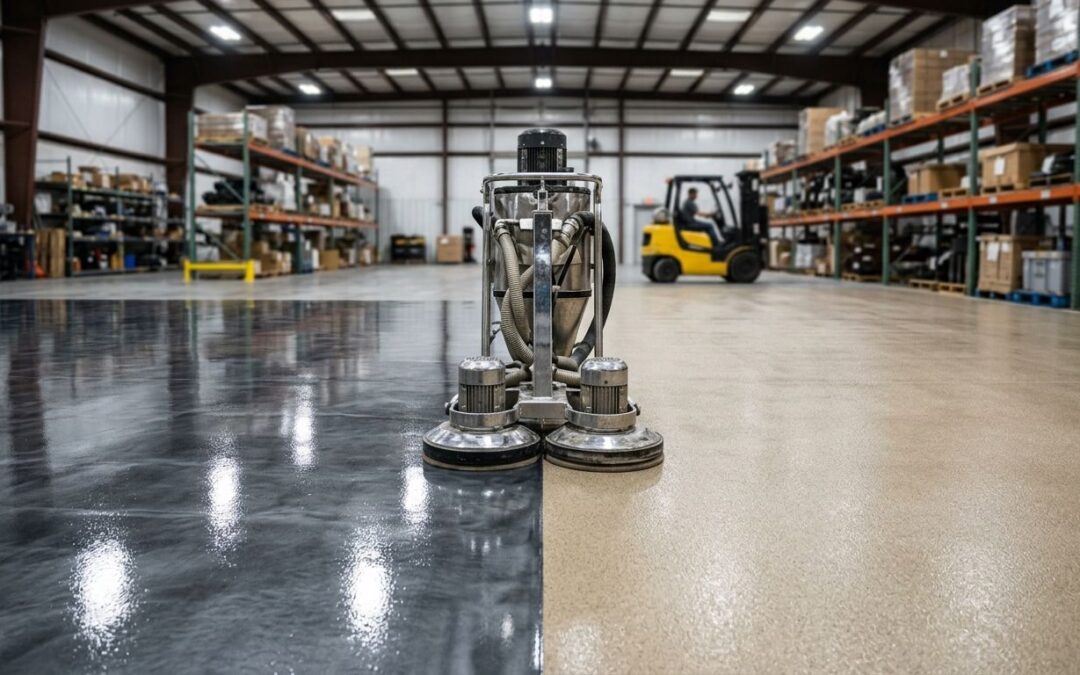
When choosing a heavy-duty floor coating, the comparison of industrial flooring systems vs polyurethane is crucial. Epoxy stands out for superior chemical resistance and bond strength, making it the go-to for facilities handling harsh substances. At Epo-Tech, our epoxy flooring services are engineered for heavy chemical exposure and mechanical wear, providing chemical resistant floor coatings that stand up to daily industrial demands. Our project gallery proves real-world durability, delivering flawless finishes your business deserves.
Polyurethane coatings offer flexibility and UV stability, but they often lack the adhesion and chemical tolerance needed in spill-prone environments. Polyaspartic floor coatings, a polyurethane-polyurea hybrid, cure more quickly and resist yellowing, yet when long-term toughness is paramount, epoxy remains the benchmark. Facility managers and specifiers count on epoxy’s proven performance for warehouses, manufacturing plants, and processing facilities where downtime from floor failure is unacceptable.
For facilities that demand uncompromising performance, Epo-Tech’s commercial and residential epoxy flooring provides the toughness required in heavy-duty environments.
Epoxy and Polyurethane Flooring Systems at a Glance
When comparing industrial flooring systems vs polyurethane coatings, it’s important to understand the fundamental differences between these two high-performance options. Epoxy flooring is a rigid, high-strength thermosetting system that excels in high-impact areas like warehouses and garages, while polyurethane flooring offers greater flexibility and UV stability, making it ideal for spaces subject to temperature swings or direct sunlight. Both systems deliver chemical resistant floor coatings, though polyurethane generally withstands a wider range of chemicals. For businesses in West Kelowna, we offer epoxy and industrial flooring in West Kelowna that provides exceptional durability and chemical resistance.
With proper maintenance, epoxy floors can last 5–10 years; polyurethane systems, including polyaspartic floor coatings, often enjoy a longer service life in milder conditions. Polyaspartic coatings, a fast-curing polyurethane variant, bring the added advantage of extremely rapid cure times and UV stability, making them suitable for projects that demand minimal downtime. Our epoxy and polyurethane systems are installed in warehouses, food processing plants, garages, and veterinary clinics across Alberta. Whether in Edmonton, Alberta, or elsewhere in the region, our team designs and installs both epoxy and polyurethane systems to match your facility’s operational demands while delivering the flawless finishes your business deserves.
Feature Comparison Between Epoxy and Polyurethane Flooring
When evaluating industrial flooring systems vs polyurethane, facility managers must consider durability, chemical resistance, UV stability, and temperature tolerance. To help you select the right solution, we compare epoxy, polyurethane, and hybrid coatings across key performance attributes.
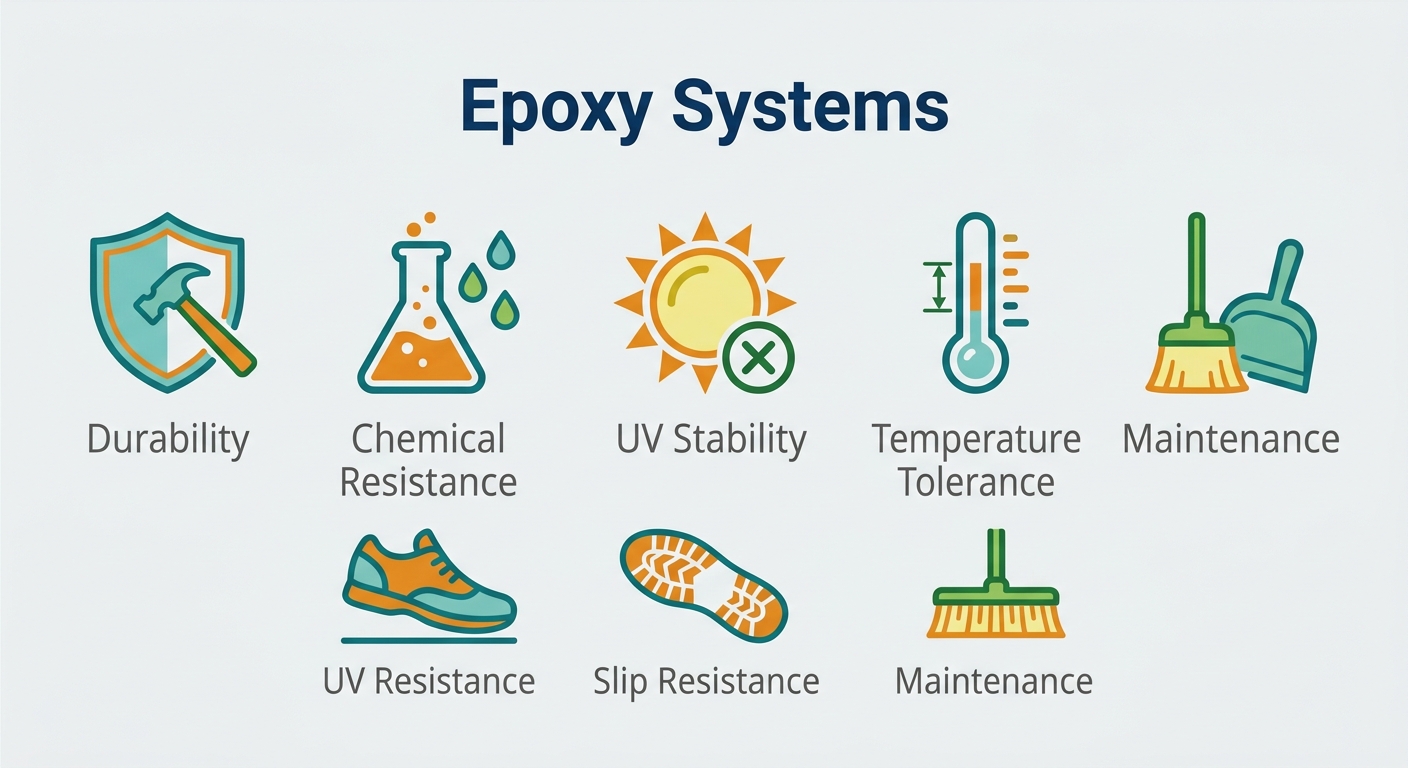
Key performance features of Epoxy Systems flooring
These chemical resistant floor coatings deliver exceptional compressive strength and acid resistance, making them a top choice for heavy-industrial spaces. However, polyurethane and hybrid systems bring unique advantages that better suit certain environments in Edmonton and across Alberta. The table below shows how the three systems compare.
| Performance Attribute | Epoxy Systems | Polyurethane Systems | Hybrid Systems |
|---|---|---|---|
| Durability | High compressive strength, excellent for heavy traffic | Superior flexibility, withstands impact and thermal shock | Combines durability of epoxy with flexibility of polyurethane |
| Chemical Resistance | Outstanding resistance to acids, solvents, and industrial chemicals | Good resistance, but may soften with prolonged solvent exposure | Balanced resistance across a wide chemical spectrum |
| UV Resistance | Prone to yellowing and degradation under direct sunlight | Excellent UV stability, ideal for loading docks and outdoor exposure | Better UV resistance than pure epoxy when polyurethane topcoat is used |
| Temperature Tolerance | Stable within moderate temperature ranges, may crack under extreme fluctuations | Handles wide temperature swings without cracking or delaminating | Enhanced thermal shock resistance due to polyurethane component |
| Slip Resistance | Moderate slip resistance; can be enhanced with aggregate additives | Naturally higher slip resistance, suitable for wet environments | Customizable slip resistance by tailoring the polyurethane topcoat |
| Maintenance Requirements | Low maintenance; requires periodic topcoat renewal in high-UV areas | Low maintenance with excellent long-term appearance under UV exposure | Low maintenance with extended service life due to combined properties |
Our comparison is grounded in national floor covering association standards for durability classification and TTMAC guidelines for chemical resistance testing, ensuring objective evaluation. For high-traffic, chemically exposed indoor areas in Edmonton, epoxy’s compressive strength and solvent resistance remain unmatched. When UV exposure is a concern, such as at loading docks or outdoor commercial spaces, polyurethane’s stability and natural slip resistance make it the superior choice. In Alberta, where seasonal temperature swings can crack rigid systems, polyurethane’s flexibility preserves long-term integrity. For balanced requirements, hybrid solutions or advanced polyaspartic floor coatings combine both benefits, making them suitable for mixed-use facilities. We’ve completed installations across Alberta that demonstrate long-term performance. Our Edmonton team has extensive experience with these systems in local conditions, and we are ready to design and install the decorative concrete surface that is right for you. Request an estimate today to discuss which system best suits your facility’s priorities.
Now that you understand the feature differences, let’s explore the installation requirements for each system.
Cost Considerations for Industrial Flooring Systems
Beyond performance characteristics, budget is a critical factor — let’s examine cost considerations for each system. When evaluating industrial flooring systems in Canada, cost depends on substrate condition, coating thickness, and site-specific requirements – never a fixed price list. Surface preparation alone can account for 20–30% of total project cost, underscoring why a custom quote is essential for an accurate budget. Because every facility has unique demands, we conduct thorough site assessments to determine the optimal system and provide a detailed, obligation-free estimate.
The following overview compares the four industrial flooring system types:
| Flooring Type | Initial Cost Range | Expected Lifespan | Maintenance Cost |
|---|---|---|---|
| Epoxy Systems | Moderate (custom quote) | 8–12 years with proper maintenance | Low; periodic topcoat renewal in UV-exposed areas |
| Polyurethane Systems | Higher (custom quote) | 10–15 years depending on exposure | Very low; excellent UV resistance reduces recoating |
| Polyaspartic Coatings | Higher (custom quote) | 12–15 years with high durability | Low; fast cure reduces downtime |
| Hybrid Epoxy-PU Systems | Moderate-to-high (custom quote) | 12–18 years with combined benefits | Low; balanced properties extend service intervals |
The table above illustrates relative cost positions and expected performance for each system type. Actual pricing remains project-specific, driven by concrete porosity, required profile depth, and total square footage. For operations requiring chemical resistant floor coatings in Edmonton, polyurethane or hybrid systems often deliver superior long-term value through reduced recoating needs. Industry benchmarks from the Concrete Floor Construction Association in Canada confirm these lifespan ranges under proper maintenance protocols. We apply polyaspartic floor coatings applied in Alberta when fast return-to-service is critical. This approach ensures you pay only for the performance your environment demands, avoiding unnecessary over-engineering or premature failure. Every estimate reflects material and labour costs calibrated to your specific conditions. To move forward, complete a “Request An Estimate” form or contact us directly — our team will evaluate your facility and recommend the safest, most cost-effective solution.
By partnering with Epo-Tech, you gain a specialist who prioritizes quality preparation and durable materials — no generic price lists, only solutions tailored to your facility’s unique conditions. Our custom-quote methodology ensures every dollar invested translates into long-term performance. Get A Quote today to see which industrial flooring system delivers the best return on investment for your operations.
Choosing Between Epoxy and Polyurethane for Your Facility
Now that you understand the basics of each coating, here is how they compare for your facility. When evaluating industrial flooring systems vs polyurethane, durability and chemical resistance are the first factors facility managers weigh.
Epoxy systems deliver exceptional hardness and scratch resistance, ideal for high-traffic industrial floors. Their dense molecular matrix offers outstanding chemical resistance—according to NFCA standards, 100% solid epoxies like the Ultra-brand formulations we use are among the most chemical resistant floor coatings available, standing up to oils, solvents, and acids. However, epoxy can yellow under UV light. For facilities seeking visual impact, metallic epoxy floor trends 2026 create a seamless, high-gloss appearance that polyurethane cannot replicate.
Polyurethane coatings, including faster-curing polyaspartic floor coatings, offer greater flexibility to accommodate thermal expansion and contraction, reducing cracking in environments with temperature swings. Their UV stability makes them the better choice for outdoor or sunlit areas where epoxy would yellow. Polyurethane cures quickly—often requiring fewer coats—and provides excellent abrasion resistance, though maintenance may need specialized cleaners.
Application also differs: epoxy typically demands primer plus two coats with longer cure times, while polyurethane can be a single-coat topcoat for faster turnaround. Our project gallery confirms successful installations of both systems in Alberta facilities from Edmonton to Kelowna. Ultimately, choose epoxy for heavy chemical exposure and high-traffic industrial floors; select polyurethane for UV-exposed areas, thermal cycling, or quick project timelines. Contact Epo-Tech for a custom quote and the flawless finishes your business deserves. Once you have selected the right coating, proper preparation and application are key to long-term performance—covered in the next section.
Invest in Durable, Safe Flooring with Expert Guidance
Choosing between industrial flooring systems and polyurethane options is a decision best guided by expertise. At Epo-Tech, we combine industry-leading Ultra-brand 100% solid epoxies and advanced surface preparation to produce durable, safe, and chemical resistant floor coatings that withstand heavy traffic. We also offer polyaspartic floor coatings for faster-curing applications. Our project gallery—featuring garages, basements, and commercial facilities—demonstrates the breadth of our capability. As a company aligned with the standards of the Terrazzo Tile Marble Association in Canada, we ensure every floor meets rigorous quality benchmarks. Our team is ready to design and install the decorative concrete surface that is right for you. Contact our team today to get a custom quote and discover the right flooring system for your facility.